

What is a talent intelligence platform?

July 17, 2026

A director of talent inherits four recruiters and 38 open reqs from last quarter. The candidate data lives in the ATS. Employee skills sit in an HRIS. Market signals scatter across LinkedIn, spreadsheets, and a sourcing tool nobody fully trusts.
Every hiring decision starts with the same problem: the information exists, but it does not connect. Deciding who to interview, which markets to hire in, and whether last year's hires actually worked out means stitching fragments together by hand.
A talent intelligence platform is built to close that gap. It brings internal workforce data and external labor market signals into one view, then turns that context into decisions about hiring, mobility, and workforce planning.
This guide defines the category, separates it from adjacent tools, and answers the questions talent leaders ask most when they evaluate one.
What is a talent intelligence platform?
A talent intelligence platform (TIP) is a technology system that aggregates and analyzes data from internal sources (an ATS, HRIS, or CRM) and external sources (the broader labor market) to produce strategic workforce insights. It combines internal workforce data with real-time market trends and competitor benchmarks to help organizations anticipate skill gaps, improve hiring outcomes, and plan ahead as the market shifts.
The distinction that matters is function. A TIP is an analytical and strategic layer, not a system for managing process. As Hyring puts it, a talent intelligence platform is the layer of insight that sits between your raw HR data and your talent decisions. It aggregates data from labor markets, skills databases, competitor profiles, and internal workforce data, then uses AI to translate that into decisions.
The strongest platforms connect pre-hire attributes to post-hire outcomes. Bryq describes this as a feedback loop: connecting candidate assessment data with post-hire performance, so hiring accuracy improves over time rather than resetting with every req.
"People intelligence platform" is used interchangeably with "talent intelligence platform." Findem launched its People Intelligence platform in 2020 and describes the discipline as the application of AI and analytics to talent acquisition and HR operations. For a fuller treatment of the category and its business case, see Findem's guide to talent intelligence as a competitive advantage.
How talent intelligence platforms differ from other HR tools
Most confusion about the category comes from tools that sit next to a TIP in the stack. Two comparisons clear it up.
| Category | Primary job | Data used | What you get |
|---|---|---|---|
| ATS/HRIS | Manage the process for internal candidates and employees | Internal records only | A system of record: applications, stages, employee files |
| AI sourcing tool | Find external candidates for open reqs | External profile data | A stream of names to contact |
| Talent intelligence platform | Inform strategy across the talent lifecycle | Internal + external, enriched with context | Decisions: who to hire, where to hire, who to promote, whether it worked |
Talent intelligence platforms vs. ATS and HRIS
An ATS and an HRIS are systems of record. They track candidates through stages and store employee data, and they do that job well. What they do not do is add outside context or generate strategy. As Hyring notes, ATS and HRIS systems manage processes, while talent intelligence platforms inform strategy by connecting external market data with internal workforce data.
A TIP does not replace the ATS. It enriches the data inside it. Findem continuously enriches candidate profiles across ATS/CRM and external sources to keep career context current: scope, outcomes, tenure, and trajectory. The record stays where it is; the intelligence layer makes it usable.
What's the difference between AI sourcing tools and full talent intelligence platforms?
An AI sourcing tool is a point solution with one job: find external candidates. It searches profiles, matches them to a req, and hands over a list. That is genuinely useful, and it is where many teams start.
A full talent intelligence platform does that and more. Its scope runs across the entire talent lifecycle: sourcing, workforce planning, competitive analysis, internal mobility, and measuring outcomes like quality of hire. Metaview frames talent intelligence as the layer above an ATS and a sourcing tool, the analytical layer that turns interview, sourcing, and workforce data into decisions.
Put simply: a sourcing tool finds candidates. A talent intelligence platform finds them, plans the workforce around them, surfaces internal people for open roles, and tracks whether the hires you made are performing.
The core capabilities of a modern talent intelligence platform
A capable TIP does several jobs that used to require separate tools and manual reconciliation. Here is what each one solves, using Findem's platform as a working model.
- Unified data foundation: A TIP consolidates people data from scattered internal and external sources into one enriched view. Findem's 3D data organizes a candidate's career across roles, teams, and milestones over time, so a profile shows how someone grew rather than a flat snapshot of titles.
- Advanced search and matching: TIPs move past keyword search to match on attributes, skills, and lived experiences. Findem enables searches based on growth patterns like 0→1 product builds or leadership under pressure, rather than only titles or keywords. This is the difference between finding people who held a job title and finding people who did the work you actually need done.
- Market intelligence and analytics: These platforms provide real-time data on where talent is, how markets shift, and which skills matter next to guide role design, locations, and growth. Findem's market intelligence also enables benchmarking hiring, growth, and retention against competitors using attributes such as experience mix, tenure, attrition, and representation.
- Internal talent optimization: A TIP surfaces internal candidates for open roles, identifies skill gaps, and supports mobility and retention. Filling a role from within is often faster and more durable than an external search, and the data to spot those matches already lives in the organization.
- Workflow automation: A TIP uses AI to accelerate work like sourcing, talent marketing, executive search, analytics, and market intelligence. Findem's assistive AI supports these workflows — sourcing assistance alone can cut sourcing time roughly in half, per the company's reporting.
What is agentic AI in talent acquisition and how does it work?
Agentic AI is an advanced form of AI where autonomous agents plan, execute, and refine multi-step workflows to reach a goal, all within human-defined boundaries. An agent understands what you want done, decides the sequence of steps, carries them out, and learns from the result.
The clearest way to separate it from earlier AI is the line Findem uses in its overview of agentic AI in HR: assistive AI answers; agentic AI acts. Assistive and generative AI respond to a prompt but do not initiate or complete a process on their own. A co-pilot drafts your outreach email when you ask. An agent runs the sourcing pass, screens against your criteria, and returns a slate without you prompting each step.
In practice, that means an agent can plan, execute, and refine multi-step workflows such as delivering interview-ready candidates. The recruiter sets the objective and the guardrails. The agent handles the sequence.
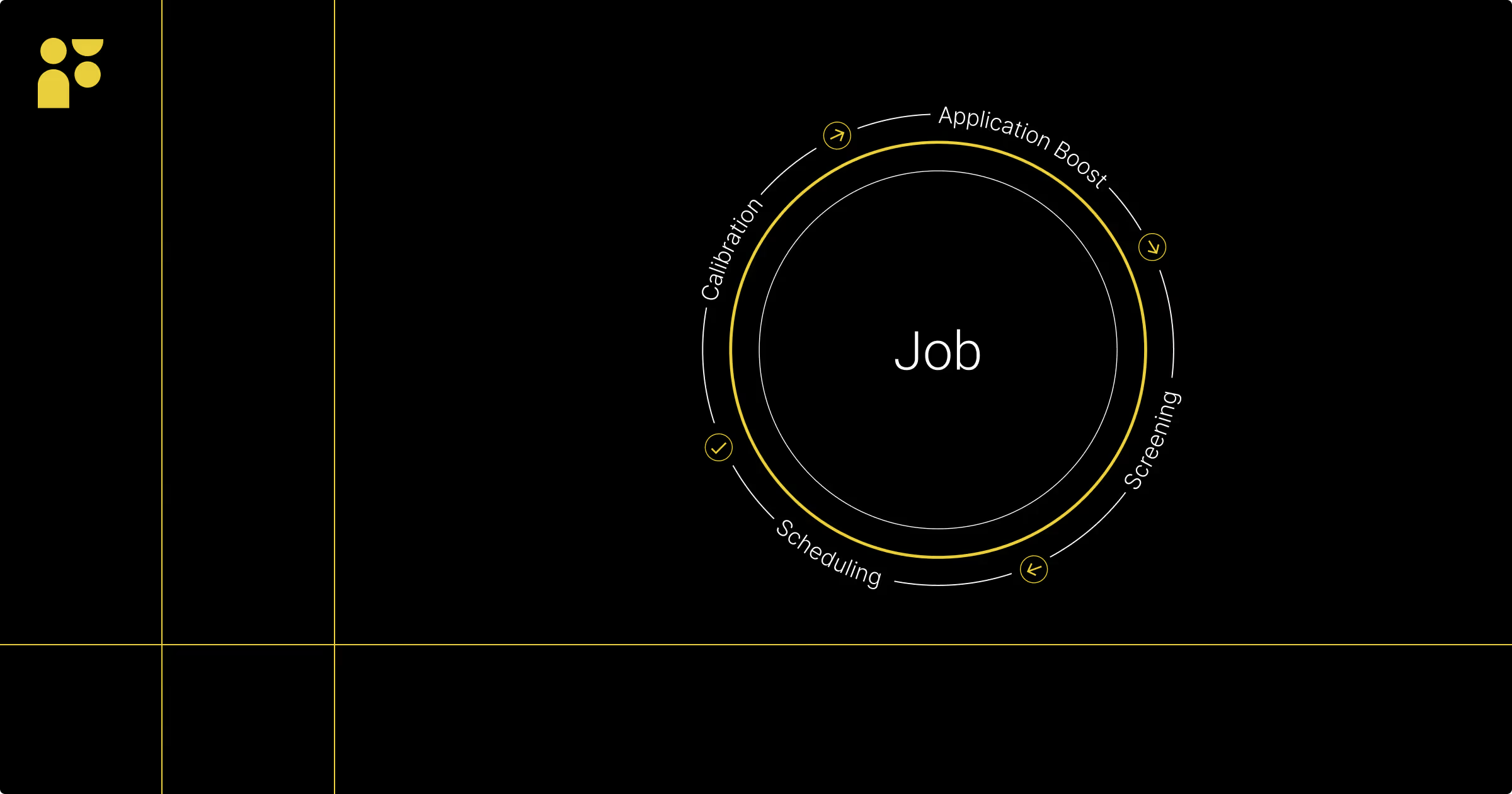
Findem's implementation is a network of agents, not a single bot. Its agentic ecosystem is a set of agents that collaborate using shared context, signals, rules, and objectives across sourcing, engagement, screening, and scheduling. Coordinating them is Fia, the Findem Intelligent Assistant, the orchestration layer that sequences workflows and maintains context across the hiring lifecycle.
Because those agents run on enriched 3D data, their actions carry context rather than guesswork, which is what makes autonomous execution reliable enough to trust. Findem has also made its intelligence layer available to agents in other systems, bringing real-time talent intelligence into agentic workflows on the ServiceNow AI Platform.
How talent intelligence supports strategic initiatives
Features matter less than what they change in practice. Two areas show the shift most clearly.
What is quality of hire and how do you measure it?
Quality of hire is a composite metric that measures how well a new hire performs and fits over time. It is not one number pulled at 90 days. It combines several signals:
- Post-hire performance ratings from managers and review cycles
- Retention rate, or whether the person stays past the first year
- Ramp time, or how quickly they reach full productivity
- Hiring manager satisfaction with the hire
Measuring it has always been hard because the pre-hire and post-hire data live in different systems and rarely connect. A talent intelligence platform provides the infrastructure to close that loop. By linking the attributes a candidate had at hire to how they performed after, the platform creates a feedback loop that continuously improves hiring accuracy. Over several cycles, that feedback tells you which signals actually predicted success, so sourcing criteria stop being guesses and start being evidence.
What are the four parts of the acronym DEIB?
DEIB stands for Diversity, Equity, Inclusion, and Belonging. Each pillar names a distinct goal, and a talent intelligence platform gives teams a way to act on each rather than report on it after the fact.
- Diversity is the representation of people across backgrounds and identities. A TIP helps by finding and engaging talent from underrepresented pools through searches based on skills and experiences rather than traditional proxies like school or title.
- Equity is fair treatment and access across the process. A TIP supports it through compensation benchmarking and evaluation that weighs the same attributes for every candidate.
- Inclusion is whether people can contribute fully once they are in. A TIP helps by identifying talent with a range of experiences, which builds teams that draw on more perspectives.
- Belonging is whether people feel they fit and want to stay. A TIP surfaces retention and internal mobility patterns across demographics, so teams can see where engagement is strong and where it is breaking down.
Evaluating talent intelligence platforms: A people intelligence platform vendor landscape
Several vendors position in or near this category, and buyers often ask what a people intelligence platform is and which vendors offer one.
Findem is an AI platform for talent outcomes, built on a proprietary 3D data layer that consolidates sourcing, CRM, analytics, and market intelligence rather than serving one task.
Among the others commonly evaluated:
- SeekOut positions around cleared, diverse, and deep technical talent and names Findem directly in its own comparisons.
- Eightfold leads with the message "Talent Intelligence meets agentic AI" and describes itself as a full-stack agentic platform spanning acquisition, management, and workforce exchange, with quote-based pricing.
- Beamery and Phenom occupy adjacent CRM and experience territory, strong on candidate engagement and marketing workflows.
- Metaview approaches the category from interview data, arguing that interview signal is "the new gap" in talent intelligence.
A note buyers should weigh: AI in recruiting carries legal exposure. A proposed class action was filed against Eightfold AI in January 2026 alleging FCRA violations, which Greenhouse flags as evidence that how AI affects candidate outcomes has legal consequences. Greenhouse also warns buyers about "AI theater," noting that most platforms marketed as AI recruiting software are traditional ATSs with AI layered on.
Use these questions when you evaluate:
- Where does the data come from, how fresh is it, and how is it verified?
- Can the platform explain why it surfaced a candidate, or is the ranking a black box?
- How does it mitigate bias, and does it support compliance requirements like FCRA and bias audits?
- Does it search on skills and experiences, or only titles and keywords?
- How does it integrate with your ATS, HRIS, and CRM?
- Does it cover the full lifecycle, or one task?
Why Findem is the platform for talent outcomes
Findem is an AI platform for talent outcomes that adds context to people data to improve talent decisions. Three things set the approach apart.
The first is the data foundation. Findem's unified platform combines structured, labeled 3D data with explainable signals. It is built on a time-ordered Talent Graph of 1.6 trillion expert-labeled data points across people, companies, and time. Findem has mapped over 1 billion career paths and created more than 2 million labeled success signals. Those Success Signals and Relationship Signals give profiles context that flat resumes cannot.
The second is that it is one platform, not a point solution. The Talent Data Cloud consolidates sourcing, CRM, candidate rediscovery, market intelligence, talent analytics, and multi-source hiring workflows. That means the same data serves the recruiter searching today and the leader planning next year's headcount. Generative AI runs across the platform, and you can explore the full scope on the Findem platform page.
The third is agentic AI grounded in that data. Findem's agents are a network that collaborates using shared context, signals, rules, and objectives across sourcing, engagement, screening, and scheduling. As Findem's team describes it, agentic AI can carry out entire workflows within the objectives and governance HR sets, giving teams precision and consistency earlier AI could not reach. People keep judgment and decisions. The agents handle the sequence.
A talent intelligence platform is what lets an organization stop reacting to open reqs one at a time and start building a workforce on evidence. The teams that make the shift move from filling seats to seeing their talent, inside and out, in higher resolution, and they plan their next hire before the seat opens rather than after it goes empty.